
Decisions with ownership
Process and quality decisions gain named owners, explicit review points, and evidence that can be challenged rather than inferred.
Process Excellence & Automation Lead · Product Builder
I’m Leandro Costa. I lead process excellence, quality, and automation in financial services, and I build products through Evorigo. My work starts with the operating problem: who owns it, how decisions are made, where evidence is missing, and how process, data, and software can improve the system without making it harder to run.
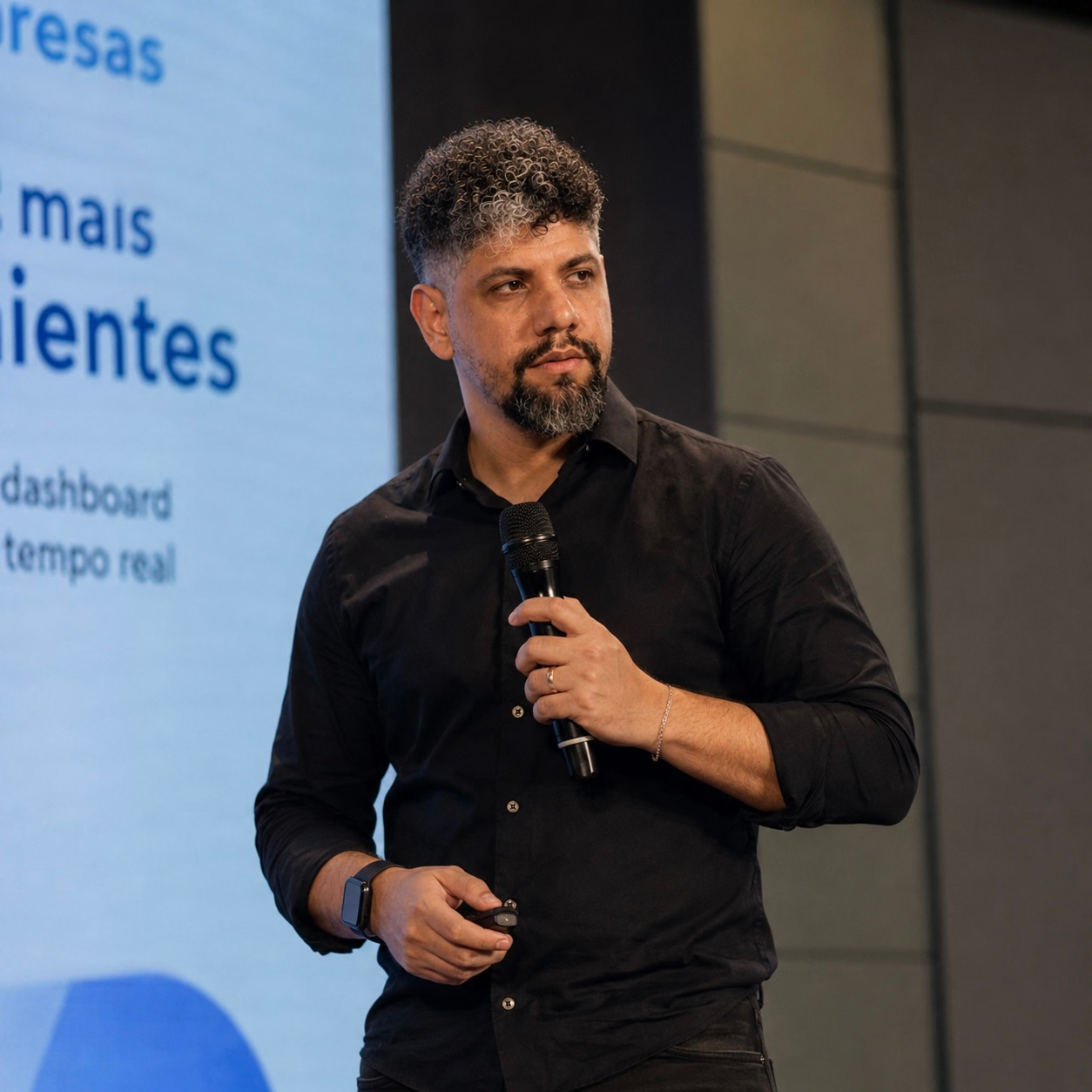
I lead the operating change, then stay close enough to the build to make it real.
Strategy, process, and technology belong in the same conversation. I clarify the operating problem, establish who decides and who owns the outcome, and define the evidence and controls the work needs. From there, I help select and build the right response, whether that means governance, process redesign, automation, data, an API, or a product.
A useful transformation leaves the organization with a clearer way to decide, deliver, measure, and improve the work after the initial project ends.
Process and quality decisions gain named owners, explicit review points, and evidence that can be challenged rather than inferred.
Demand is assessed by value, risk, stability, support, and architecture instead of entering an undifferentiated queue of scripts.
Product decisions remain connected from problem framing through architecture, implementation, release, and the operating consequences that follow.
These cases cover process governance, automation portfolio management, and product building through Evorigo. Corporate details remain anonymized, while the decisions, constraints, and operating methods are described in enough depth to be evaluated.
View all workA management system that gives process ownership, quality standards, improvement demand, and leadership decisions a shared operating cadence in a complex environment.
A portfolio model for deciding when automation is justified, choosing the right intervention, and carrying ownership from discovery through support and retirement.
A founder-led product practice that carries one decision loop from problem framing and scope through architecture, implementation, platform readiness, and release.
My path has grown from studying how work moves to leading the standards, decision systems, automation direction, and cross-functional delivery that shape it. Product building adds another layer: direct responsibility for turning a decision into architecture and working software.
View experienceCurrent
Financial services institution
Leads process excellence, quality, governance, and automation direction. Turns transformation priorities into clear ownership, decision routines, standards, and delivery across functions.
Independent venture
Evorigo
Defines product scope and technical decisions, with direct involvement in architecture, software development, infrastructure, security, observability, and release readiness.
I use technology to change a specific operating condition: reduce manual coordination, improve decision quality, make a control observable, create a reliable service, or give a product room to scale. The technical foundation follows the problem, the risk, and the capability available to operate it.
Make work and ownership visible, establish decision and review routines, then automate only where process stability, risk, and support make the operating case sound.
Structure operational evidence so leaders and systems can use it for decisions, monitoring, reliable services, and analysis that changes what happens next.
Carry a product decision into consistent mobile, web, service, and API implementation without losing the user need, operating constraint, or release boundary that justified it.
Build delivery environments that are repeatable, observable, recoverable, and proportionate to the product risk, team capability, and support commitment.
Define trust boundaries, authentication, data flows, failure behavior, abuse controls, and resilience mechanisms while architecture is still being shaped.
At Evorigo, I take direct responsibility for product decisions. I define the problem worth solving, narrow the scope, choose the architecture, contribute to implementation, and account for security, infrastructure, observability, and release. Each initiative is described according to its actual maturity, with the reasoning behind its decisions open to evaluation.
Visit EvorigoDefine the user, operating problem, and evidence needed for the next decision before selecting the technical foundation.
Make product, architecture, security, cost, and delivery trade-offs visible while they can still be changed.
State clearly whether an initiative is a concept, prototype, active development effort, or production system.
My writing examines the decisions that determine whether transformation lasts after launch: ownership, prioritization, exception handling, adoption, architecture, support, and the discipline to change course when the evidence does not support the original plan.
InsightsHow ownership, decision rights, management cadence, evidence, and feedback loops turn isolated improvement projects into a capability the organization can operate repeatedly.
How to evaluate process stability, value, risk, data quality, dependencies, maintainability, support, and adoption before deciding whether automation is the right intervention.
How product decisions improve tools for operations and regulated environments by clarifying users, constraints, outcomes, release boundaries, and the evidence needed for the next iteration.
A useful first conversation starts with the real context: what is failing, who owns the consequence, which constraints matter, and what decision needs attention.